
Every metal bed frame supplier makes claims about strength.
" Heavy-duty construction." "Supports up to 500 pounds." "Built to last."
But what do these claims actually mean? And more importantly—how can you verify them?
For importers and wholesalers, understanding load testing isn't just technical curiosity. It's about liability, warranty costs, and customer trust. If you sell a bed rated for 300 pounds and it collapses under a 250-pound person, you have a problem. A big, expensive, reputation-damaging problem.
This guide explains how load testing works, what weight limits actually mean, and how to ensure the beds you import can handle what your customers throw at them.
What Is Load Testing?
Load testing is the process of applying weight to a metal bed frame to determine its maximum capacity before failure—or to verify it meets a specified safety standard.
Think of it as stress-testing your product before your customers do.
For a metal bed frame, load testing typically involves:
- Static load testing: Placing weights on the bed and measuring deflection (bending) over time
- Dynamic load testing: Simulating repeated use (sitting, lying down, getting up)
- Impact testing: Simulating someone jumping or dropping onto the bed
- Edge testing: Applying weight to the sides where leverage is greatest
Why Load Testing Matters for Wholesale Buyers
You might be thinking: "I'm not an engineer. I just buy and sell metal bed frames."
Here's why you should care:
1. Liability Protection
If a metal bed frame fails and someone gets hurt, you could be legally responsible. In the US, furniture liability lawsuits can reach six or seven figures. Knowing your product's true capacity protects you and your customers.
2. Warranty Costs
Every returned bed costs you money. If your beds fail under normal use, your warranty claims will eat your profits. Load testing helps you set realistic weight limits that minimize failures.
3. Marketing Claims
"Supports up to 400 pounds" is a powerful marketing message—but only if it's true. False claims lead to angry customers and bad reviews.
4. Market Positioning
Different customers need different weight capacities. Understanding load testing lets you target the right segments with the right products.
Industry Standards: What "Heavy-Duty" Really Means
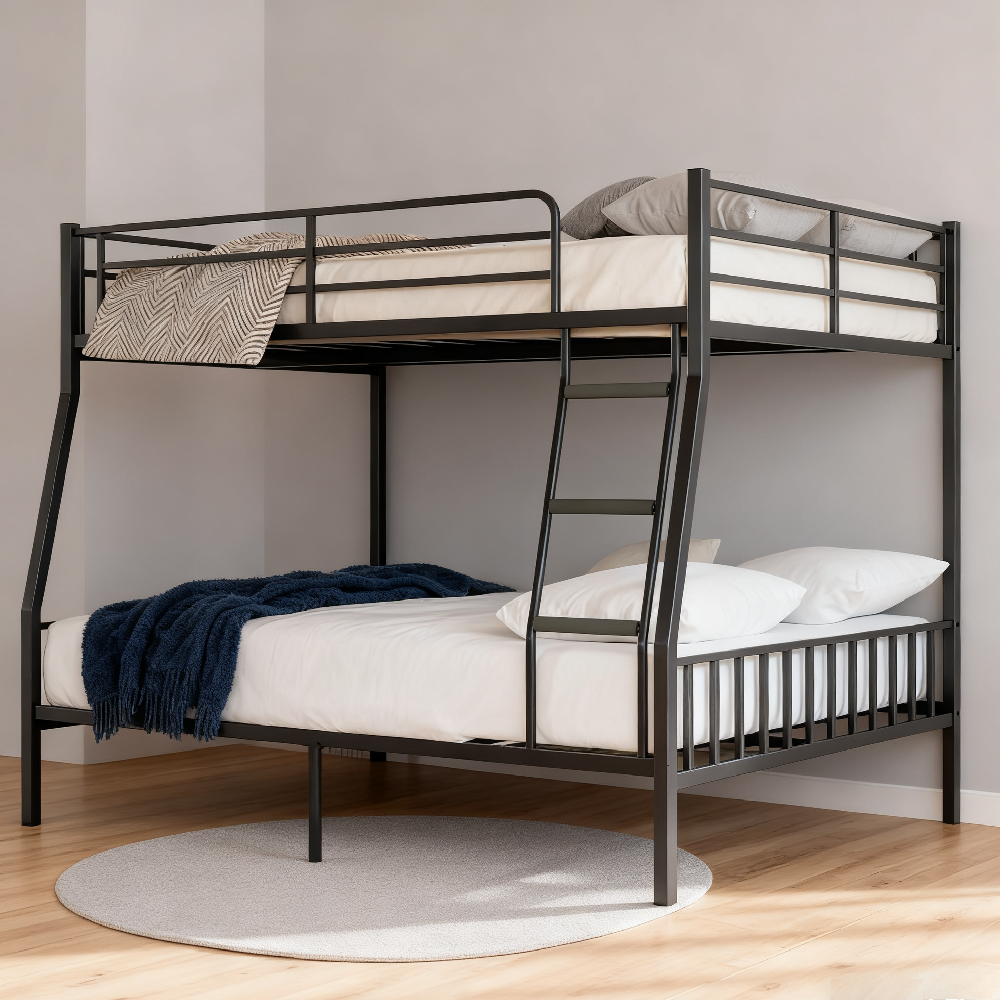
In the furniture industry, there are recognized standards for metal bed frame strength. The most common reference is the ASTM (American Society for Testing and Materials) standards, particularly ASTM F1427 (standard for bunk beds) and related furniture safety standards.
Here's what typical ratings mean:
| Rating | Weight Capacity | Typical Use |
|---|---|---|
| Standard | 200-250 lbs (90-113 kg) | Children, average adults |
| Heavy-Duty | 300-400 lbs (136-181 kg) | Larger adults, daily use |
| Bariatric | 500-800 lbs (227-363 kg) | Medical, plus-size individuals |
| Commercial | 400-600 lbs (181-272 kg) | Hotels, hostels, dorms |
Important: These are typically static load ratings—the weight the bed can hold when stationary. Dynamic loads (movement) create additional stress.
The Testing Process: How It's Done
If you want to verify your supplier's claims, here's what professional load testing looks like:
Static Load Test
Method:
- The assembled bed is placed on a level surface
- Weights are gradually added to the sleeping surface
- Measurements are taken at key points to detect deflection (bending)
- Weight is increased until failure or target capacity is reached
What They Measure:
- How much the frame bends under load
- At what point permanent deformation occurs
- The maximum weight before catastrophic failure
Passing Criteria:
For ASTM standards, a bed typically must support at least 400 pounds applied to the center for bunk beds (upper bunk) and similar requirements for single beds. Deflection limits are specified (usually less than a certain amount of bend).

Dynamic Load Test
Method:
- A weighted "drum" or impactor is dropped repeatedly onto the bed
- Typically 100-1,000 cycles to simulate months of use
- The bed is inspected for damage after testing
What They Measure:
- Fatigue resistance over time
- Joint integrity under repeated stress
- Weld durability
Passing Criteria:
No visible damage, loosening of joints, or permanent deformation after the test cycle.
Edge Load Test
Method:
- Weight is applied to the edge of the bed (where someone might sit)
- Tests the leverage stress on side rails and connections
Why It Matters:
People sit on the edge of beds constantly. This is often where cheaper beds fail first.
The Weak Points: Where Beds Fail
Understanding where beds break helps you know what to inspect:
1. The Center Span
The middle of the bed bears the most weight. Without adequate center support (legs or cross braces), the frame will sag or bend over time.
What to Check: Does the bed have a center support leg? Are the cross braces sturdy?
2. The Joints
Where side rails connect to headboard and footboard is the most stressed point in the frame. Loose bolts or weak welds fail here first.
What to Check: Are the connection plates thick enough? Are bolts grade 8.8 or higher? Are there at least two bolts per connection?
3. Weld Points
Poor welds create stress concentrations where cracks can start.
What to Check: Are welds continuous? Smooth? Free of cracks or voids?
4. Slat Supports
The slats themselves or the rails that hold them can fail, dropping the mattress through the frame.
What to Check: Slat thickness (minimum 8-10mm for wood). Slat spacing (no more than 2-3 inches apart). Center support for slats.
Real Numbers: What Different Steel Gauges Can Hold
Based on industry testing, here are approximate load capacities for different steel thicknesses (assuming good design with center support):
| Steel Thickness | Typical Max Load | Notes |
|---|---|---|
| 1.0mm (18-gauge) | 200-250 lbs | Budget beds, light use only |
| 1.2mm (16-gauge) | 250-350 lbs | Standard residential, most common |
| 1.5mm (16-gauge heavy) | 350-450 lbs | Heavy-duty residential, light commercial |
| 2.0mm (14-gauge) | 450-600+ lbs | True commercial, bariatric capable |
Important: These are estimates for well-designed frames. Poor design can dramatically reduce capacity regardless of steel thickness.

How to Verify Supplier Claims
Don't just take your supplier's word for it. Here's how to verify:
1. Request Test Reports
Ask for third-party load test reports from recognized labs.
What to look for: Date of test, lab name, sample size, test methods, and results. Reports should show the actual weight applied and the outcome.
2. Order Samples and Test Yourself
You don't need a lab to do basic testing:
- The "jump test": Have a heavy team member sit, lie, and gently bounce on the bed. Does it feel solid? Any creaks or flex?
- The edge test: Have someone sit on the edge repeatedly. Does the frame twist?
- The long-term test: Keep a sample assembled in your office for months. Does it develop looseness or squeaks?
3. Ask About Production Testing
Does the factory test random samples from each production batch? Or only prototype samples?
The right answer: Reputable factories do both—initial design testing and ongoing batch testing.
4. Check the Hardware
Even with thick steel, weak bolts or thin connection plates can cause failure.
What to check:
- Bolt grade (look for markings indicating grade 8.8 or higher)
- Connection plate thickness (should match or exceed tube thickness)
- Number of bolts per joint (2 is minimum, 3-4 is better)
Matching Capacity to Market
Different customers need different ratings. Here's how to position your products:
| Target Customer | Recommended Rating | Selling Point |
|---|---|---|
| Children (ages 3-10) | 200-250 lbs | "Grows with your child" |
| Average adult | 300-350 lbs | "Supports most adults comfortably" |
| Plus-size individuals | 400-500 lbs | "Heavy-duty construction for everyone" |
| Couples (sharing a single?) | 400+ lbs | "Built for two" (rare, but happens) |
| Commercial / Hotels | 400-600 lbs | "Commercial-grade durability" |
| Bariatric / Medical | 600-800+ lbs | "Certified medical-grade strength" |
The Safety Factor: Why You Need Margin
Professional engineers design with safety factors. If a bed is rated for 300 pounds, it should be tested to at least 450-600 pounds without failure.
Why?
- Dynamic loads are higher than static loads
- Manufacturing variations occur
- People occasionally jump on beds
- Weight distribution matters
For wholesale buyers: Ask about the safety factor. A supplier who understands this concept is more professional than one who just quotes a number.
Your Load Testing Checklist
Before placing your next order, verify:
| Check | What to Confirm |
|---|---|
| Test Reports | Third-party testing from recognized lab |
| Test Configuration | Matches exactly what you're buying |
| Static and Dynamic | Both types were performed |
| Safety Factor | At least 2:1 margin |
| Batch Testing | Ongoing quality checks |
| Hardware Grade | Bolts and plates match frame strength |
| Mattress Allowance | Capacity includes mattress weight |
The Bottom Line
Load testing isn't just technical paperwork—it's your protection against liability, warranty claims, and reputation damage.
When a supplier says their bed holds 400 pounds, ask to see the proof. When they can't provide it, assume the worst. When they can, you've found a professional partner who takes quality seriously.
In the metal bed frame business, strength isn't a marketing claim. It's a promise. Make sure your suppliers keep it.