

When purchasing a steel locker, one of the most common questions is: How many doors should I choose?
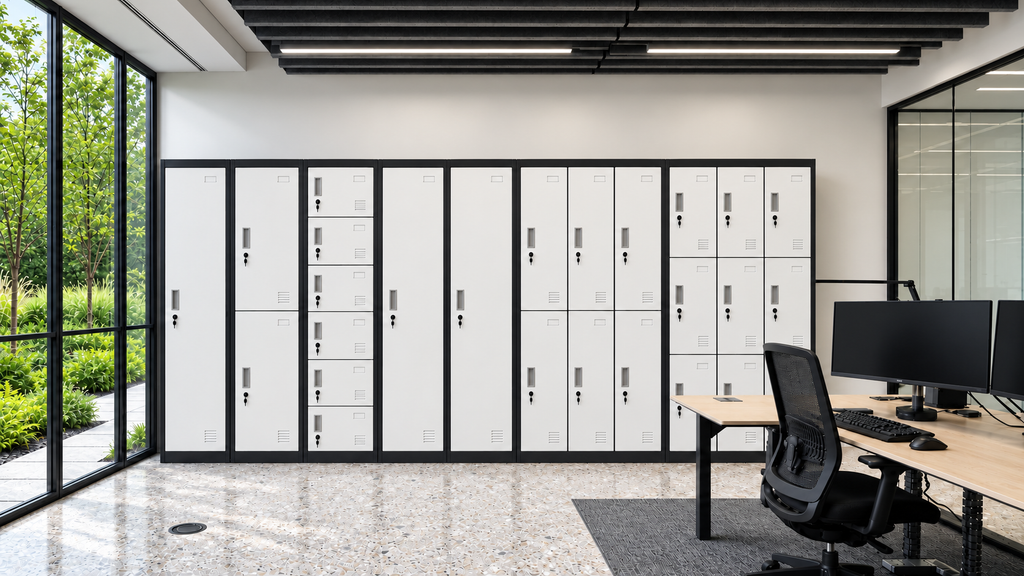
Steel lockers are available in many configurations. A single-column locker commonly has 1–6 doors, while multi-column lockers can be configured with approximately 2–18 doors. Common designs use 2–4 columns and 1–6 rows, allowing buyers to create different combinations according to the number of users and the available installation space.
However, more doors do not necessarily mean a better locker. Fewer doors generally provide larger individual compartments, while more doors allow more people to have independent storage within a similar footprint.
For schools, factories, offices, gyms, changing rooms, and other commercial projects, the right choice depends mainly on what users need to store, how many people need lockers, and how much installation space is available.
1. Choose the Number of Doors According to What You Need to Store
The first question to consider is not “How many doors do I need?” but rather:
What does each user need to store?
If users need to store workwear, uniforms, coats, backpacks, shoes, or other relatively large items, each person will need a larger compartment. In this case, a locker with fewer doors is usually more practical.
If users only need storage for phones, wallets, keys, documents, small bags, and other personal belongings, smaller compartments can be used, allowing more doors to be added to the same locker.
A simple rule is:
Larger items → Fewer doors + Larger compartments
Smaller items → More doors + Smaller compartments
Another important consideration is the hanging rail.
When a steel locker has fewer than 3 rows, such as a 1-row or 2-row configuration, the individual compartments usually provide enough vertical space to add a hanging rail, depending on the cabinet dimensions and project requirements.
A 1-row locker, for example, can provide a full-height personal storage area with a hanging rail, hooks, and shelves, making it suitable for uniforms, workwear, jackets, and other clothing.
A 2-row locker can provide storage for more users while still allowing a hanging rail to be added when the compartment dimensions are suitable.
Once the design reaches 3–6 rows, each compartment becomes more compact. These configurations are generally more suitable for folded clothes, shoes, backpacks, personal belongings, and smaller items rather than hanging longer garments.
Therefore, the internal function of the locker should be considered together with the number of doors.
2. Use Rows and Columns to Determine the Right Locker Configuration
The total number of steel locker doors can be understood as a combination of rows and columns.
For a single-column locker, the cabinet can commonly be divided into 1–6 rows, creating 1–6 individual doors.
As the number of rows increases, the height of each compartment generally decreases.
For example, a 1-row locker provides a large vertical compartment. A 2-row locker divides the cabinet into two larger personal storage areas. A 3-row design provides a balance between compartment capacity and the number of users, while 4–6 rows are better suited to higher-density personal storage.
When more users need to be accommodated, additional columns can be added. Common multi-door steel lockers usually have 2, 3, or 4 columns.
Typical combinations include:
| Configuration | Total Doors | Storage Characteristics |
|---|---|---|
| 2 columns × 1 row | 2 doors | Large individual compartments |
| 2 columns × 3 rows | 6 doors | Medium personal storage |
| 3 columns × 3 rows | 9 doors | Balanced multi-user storage |
| 3 columns × 4 rows | 12 doors | Higher storage density |
| 4 columns × 4 rows | 16 doors | Multi-user small-item storage |
| 3 columns × 6 rows | 18 doors | High-density personal storage |
The exact compartment dimensions will depend on the product design, but the basic principle is simple:
Rows determine compartment height, columns determine horizontal capacity, and rows × columns determine the total number of doors.
For a narrow installation area, fewer columns may be more practical. If a project has a long wall, more columns or several modular locker units can be placed side by side.
3. Match the Number of Doors to the Number of Users and Available Space
For B2B buyers and project procurement, the number of users is another important consideration.
For example, imagine a factory needs lockers for 100 employees.
If every employee needs to store a uniform, coat, backpack, and shoes, using very small compartments simply to increase the number of doors would not be practical. Larger compartments with fewer doors would provide more useful personal storage.
However, if those 100 employees only need secure compartments for phones, wallets, keys, and small personal belongings, 9-door, 12-door, 15-door, or 18-door steel lockers can provide much higher storage density within the available space.
Different applications therefore require different configurations.
For factories and staff changing rooms, larger compartments may be preferred when employees need to store workwear, uniforms, bags, or shoes.
For schools and universities, the appropriate compartment size depends on whether students are storing books, bags, clothing, or only personal belongings.
For offices and personal-item storage areas, multi-door lockers can help provide a large number of individual compartments without occupying excessive floor space.
For gyms and changing rooms, buyers need to balance clothing storage capacity with the total number of users.
Large projects can also use a modular approach. Instead of manufacturing one extremely wide locker bank, several 2-column, 3-column, or 4-column locker units can be installed side by side.
This approach can make transportation, installation, room planning, future expansion, and replacement more flexible.

4. After Choosing the Door Count, Consider Hanging Rails, Locks, Ventilation, and Accessories
Choosing between a 6-door, 9-door, 12-door, or 18-door steel locker is only part of the purchasing decision. The internal configuration and accessories should also match the intended application.
As mentioned above, steel lockers with fewer than 3 rows can be equipped with hanging rails when the compartment dimensions allow. Hooks and shelves can also be added to create a more complete clothes-storage solution.
This type of configuration is particularly useful for employee changing rooms, factories, offices, schools, and other environments where users need to hang uniforms, jackets, or workwear.
For lockers with 3–6 rows, the design can focus more on shelves, ventilation, and compact personal storage.
The locking system should also be considered. Depending on the project, lockers can be equipped with key locks, padlock-compatible locks, combination locks, electronic locks, or other customized locking solutions.
Ventilation is another useful feature when storing clothes, shoes, or sports equipment. Different ventilation hole patterns can be incorporated into the door design according to the product style and application.
For larger projects, these details are important because a locker is not simply a steel cabinet with multiple doors. It needs to provide the right combination of storage capacity, user access, security, ventilation, and internal organization.
So, How Many Doors Should Your Steel Locker Have?
A practical selection process is:
What will be stored → Determine compartment size → Choose 1–6 rows → Add a hanging rail for fewer than 3 rows when required → Choose 2–4 columns → Calculate total doors → Match the configuration to the number of users.
For large clothing, uniforms, and backpacks, choose fewer doors and larger compartments.
For small personal belongings, choose more doors to increase storage density.
For projects requiring hanging clothes, 1-row and 2-row configurations can accommodate hanging rails when dimensions permit.
Ultimately, the best steel locker is not necessarily the one with the most doors. It is the one that provides the right compartment size for the required number of users while making efficient use of the available space.
RUIJIA Furniture – Custom 1–18 Door Steel Locker Solutions
As a professional steel locker manufacturer, RUIJIA Furniture provides locker solutions for furniture distributors, wholesalers, importers, brands, contractors, schools, factories, offices, gyms, and bulk procurement projects.
Our common configurations include 1–6 door single-column steel lockers and approximately 2–18 door multi-column lockers, with common designs using 2–4 columns and 1–6 rows.
Depending on the target market and project requirements, we provide OEM and ODM customization for locker dimensions, rows, columns, number of doors, compartment sizes, steel thickness, hanging rails, hooks, shelves, ventilation holes, locks, handles, colors, logos, and packaging.
Whether you need large steel lockers with hanging rails for employee uniforms or high-density multi-door lockers for personal belongings, RUIJIA Furniture can develop the appropriate configuration according to the number of users, storage requirements, and installation space.