
In a factory environment, an employee locker is more than just a cabinet for personal belongings. It is an important part of the changing room, staff area, and daily workplace management system.
Factory employees need lockers for workwear, shoes, bags, and personal belongings. Compared with ordinary office storage, factory lockers are often used by more people and at a higher frequency. They also need to consider clothing storage, ventilation, security, cleaning, and efficient use of changing room space.
Choosing the right factory steel locker depends on the number of employees and their storage needs. Available space and management requirements should also be considered.
1. Design Factory Lockers Around What Employees Need to Store
Different factories can have very different locker requirements.
In many manufacturing facilities, employees change into uniforms or workwear before starting their shifts. Their personal lockers may therefore need enough space for jackets, everyday clothing, backpacks, shoes, and other belongings.
In this situation, choosing a locker with too many small compartments simply to accommodate more users may not be practical. Each employee needs sufficient usable storage space.
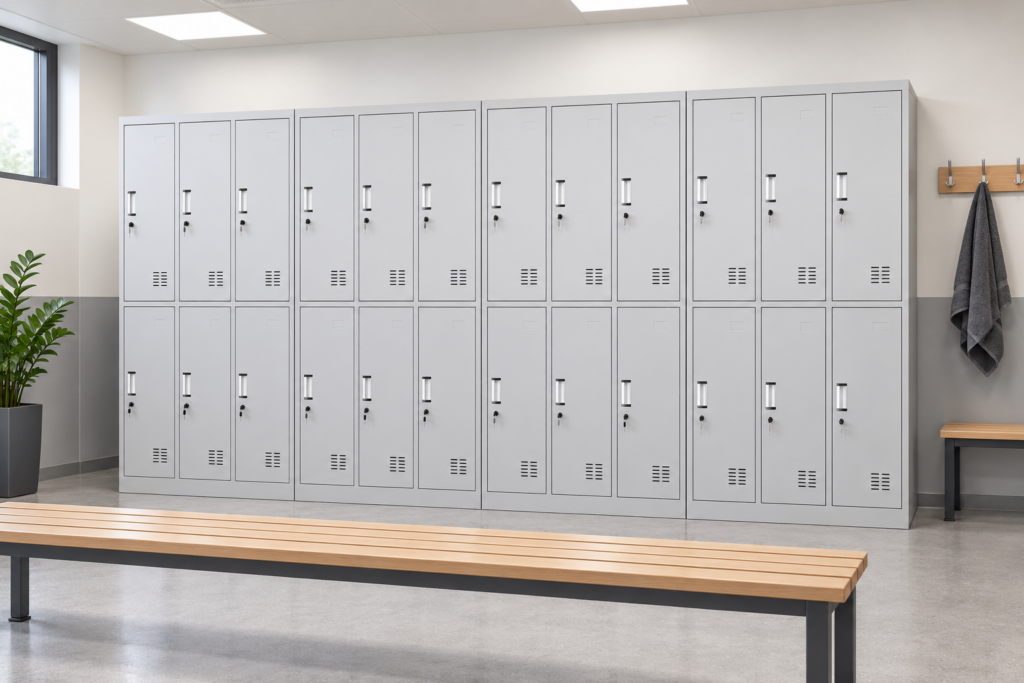
For factories where employees need to hang uniforms, workwear, or jackets, 1-row or 2-row steel lockers are often suitable options. When the locker has fewer than three rows and the compartment dimensions allow, a hanging rail can be installed inside. Shelves and hooks can also be added to organize clothing and other personal items.
A full-height single-door employee locker provides ample vertical space for hanging clothes. A 2-row configuration can serve more employees while still offering relatively large individual compartments.
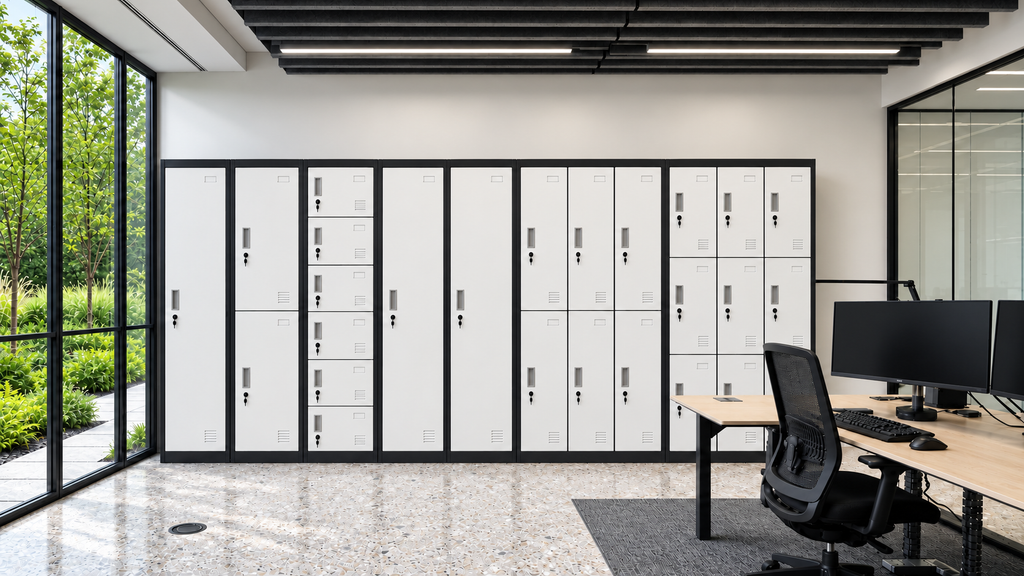
If employees mainly need to store phones, wallets, keys, small bags, or other compact personal belongings, a 3–6 row multi-door locker can provide more individual compartments within the same general footprint.
The first question when planning a factory locker project should therefore be:
What does each employee actually need to store?
Once this is clear, it becomes much easier to determine the appropriate compartment size, number of doors, and internal configuration.
2. Match Locker Configuration to Employee Numbers and Changing Room Space
Factories can have dozens, hundreds, or even thousands of employees, so efficient use of changing room space is an important part of locker planning.
RUIJIA Furniture's common steel locker configurations can include 1–6 doors in a single column and approximately 2–18 doors in multi-column designs. Common layouts use 2–4 columns and 1–6 rows, allowing different configurations to be created for different projects.
For employees who need to store workwear, jackets, backpacks, and shoes, fewer rows can provide larger individual compartments.
For smaller personal belongings, more rows can be used to increase the number of independent storage spaces within the available area.
Large factory projects can also use a modular locker system. Instead of using one extremely wide locker bank, factories can arrange multiple 2-column, 3-column, or 4-column units side by side.
This approach provides greater flexibility for transportation and installation and makes it easier to adapt the locker arrangement to walls, doors, windows, columns, and other features of the changing room. Additional locker units can also be added later if the workforce expands.
For a factory locker project, three pieces of information are particularly useful at the planning stage:
Number of employees + Storage requirements per employee + Available changing room space
Based on these factors, the appropriate compartment size, rows, columns, number of doors, and total quantity of lockers can be determined.
3. Consider Hanging Rails, Ventilation, Locks, and Daily Management
A factory locker is different from a standard office cabinet because it often stores clothing, shoes, uniforms, and work-related personal items.
Ventilation can therefore be an important feature. Ventilation holes can be incorporated into the locker doors to support airflow inside the compartments, particularly when employees are storing workwear or shoes.
For larger compartments, internal accessories can include hanging rails, hooks, and shelves. Factories can add hanging rails to 1-row and 2-row lockers when the internal dimensions allow. This configuration works well for employees who need to hang uniforms or jackets.
Factories should also consider security and access management. Depending on their requirements, they can choose key locks, padlock-compatible locks, combination locks, electronic locks, or other customized locking systems for employee lockers.
For a small changing room, lock management may be relatively simple. For a large manufacturing facility with hundreds of individual locker doors, however, numbering and access management become much more important.
Locker doors can be numbered to help employees identify their assigned compartments, while different locker groups can be arranged according to departments, production areas, or shifts.
Daily maintenance should also be considered. A properly finished powder-coated steel surface is easy to clean, while regular inspection of hinges, locks, handles, and other frequently used components can help keep lockers functioning properly over long-term use.
4. Factory Locker Projects Often Require Customization
A standard locker specification cannot meet the requirements of every factory.
Employee numbers, changing procedures, workwear, room dimensions, local market requirements, and management systems can vary considerably between projects.
For this reason, OEM and ODM manufacturing allows factory lockers to be adapted to specific requirements.
Depending on the project, customization can include locker height and width, steel thickness, number of rows and columns, compartment dimensions, hanging rails, hooks, shelves, ventilation patterns, locks, handles, colors, numbering, logos, and packaging.
Color customization can also support factory organization and branding. Factories can use different colors to distinguish departments, work areas, or employee groups. Custom finishes can also match the lockers with the company’s interior design or brand identity.
For large international projects, manufacturers should also consider packaging and transportation during product development. They can optimize the cabinet structure and packaging for container loading, product protection, transportation, and destination assembly.
A complete factory locker project therefore involves more than choosing a cabinet from a catalog. It requires consideration of the entire process, from locker configuration and mass production to packaging, transportation, installation, and everyday employee use.
RUIJIA Furniture – Custom Steel Locker Solutions for Factories
As a professional steel locker manufacturer, RUIJIA Furniture provides bulk manufacturing and OEM/ODM solutions for factories, manufacturing facilities, industrial parks, warehouses, staff changing rooms, and other commercial projects.
Our locker range can include large 1-row and 2-row employee lockers with hanging rails for uniforms and workwear, as well as multi-door steel lockers for smaller personal belongings. Common configurations range from 1–6 doors in a single column to approximately 2–18 doors in multi-column designs, with different row and column combinations available according to project requirements.
For factory buyers, contractors, distributors, wholesalers, and industrial furniture importers, RUIJIA Furniture can customize dimensions, compartment layouts, steel thickness, hanging rails, shelves, ventilation, locks, colors, logos, numbering, and packaging according to the application.
The goal of a well-designed factory locker system is not simply to provide as many doors as possible. It is to give each employee an appropriate personal storage space while helping the factory make efficient use of the available changing room area.