

When purchasing a filing cabinet for an office, one of the most common questions is: How many drawers should I choose?
The answer is not simply “the more, the better.” The right number of drawers depends on several factors, including cabinet height, storage capacity, available office space, mobility, filing habits, and the number of people using the cabinet.
At Dongzhixin Furniture, we manufacture steel filing cabinets in a variety of heights and drawer configurations for offices, distributors, wholesalers, and commercial projects. Based on our experience, here are six practical factors to consider when choosing the right number of filing cabinet drawers.
1. Choose the Number of Drawers Based on Cabinet Height
Cabinet height is one of the easiest ways to narrow down your options.
Taking our standard filing cabinet range as an example:
| Drawer Configuration | Standard Height | Typical Application |
|---|---|---|
| 2 Drawers | 731 mm | Workstations, beside desks, personal storage |
| 3 Drawers | 1031 mm | General offices and departmental storage |
| 4 Drawers | 1331 mm | Offices and centralized file storage |
| 5 Drawers | 1633 mm | Archives and high-capacity storage areas |
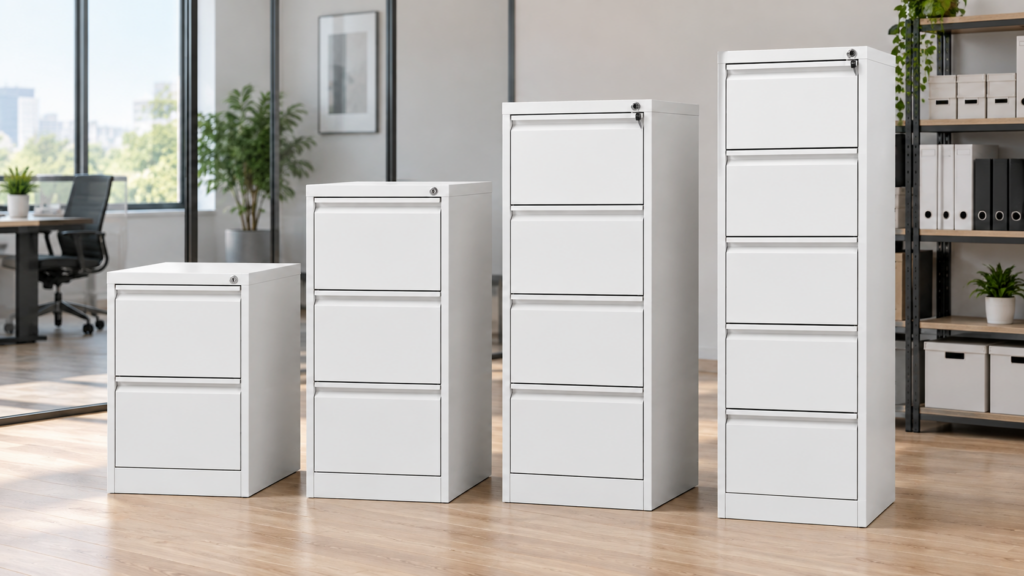
If you want to maintain an open office environment with lower furniture, a 2 drawer or 3 drawer filing cabinet may be more appropriate.
When floor space is limited but vertical space is available, a 4 drawer or 5 drawer filing cabinet can provide more storage capacity without significantly increasing the cabinet footprint.
So before deciding how many drawers you need, first ask:
How tall can the filing cabinet be in the intended location?
2. Consider How Many Files You Need to Store
Storage capacity is another important factor when determining the number of drawers.
For employees who mainly store frequently used contracts, customer information, quotations, and current project documents, a 2 or 3 drawer filing cabinet may provide sufficient capacity while keeping files within easy reach.
Departments such as finance, HR, administration, and records management usually handle larger quantities of documents. In these situations, a 4 or 5 drawer filing cabinet can provide more centralized storage.
For larger offices, it is also possible to combine different configurations. For example, lower cabinets can be used for personal files, while taller cabinets provide centralized departmental storage.
This creates a more efficient filing system than simply purchasing the same cabinet for every employee.
3. Consider Available Floor Space
The number of drawers can also affect how efficiently you use office space.
When filing cabinets have a similar footprint, increasing the number of drawers allows you to gain additional storage capacity vertically.
For example:
More floor space + fewer files → 2 or 3 drawers
Limited floor space + more files → 4 or 5 drawers
This is why taller filing cabinets are commonly used in archives, administrative departments, schools, institutions, and commercial offices where large quantities of documents need to be stored within a limited area.
4. Consider Mobility: Does the Filing Cabinet Need to Move?
Mobility is often overlooked when choosing the number of drawers.
Once a filing cabinet is fully loaded with documents, its total weight can increase significantly. Therefore, taller cabinets with more drawers are generally better suited to fixed storage locations.
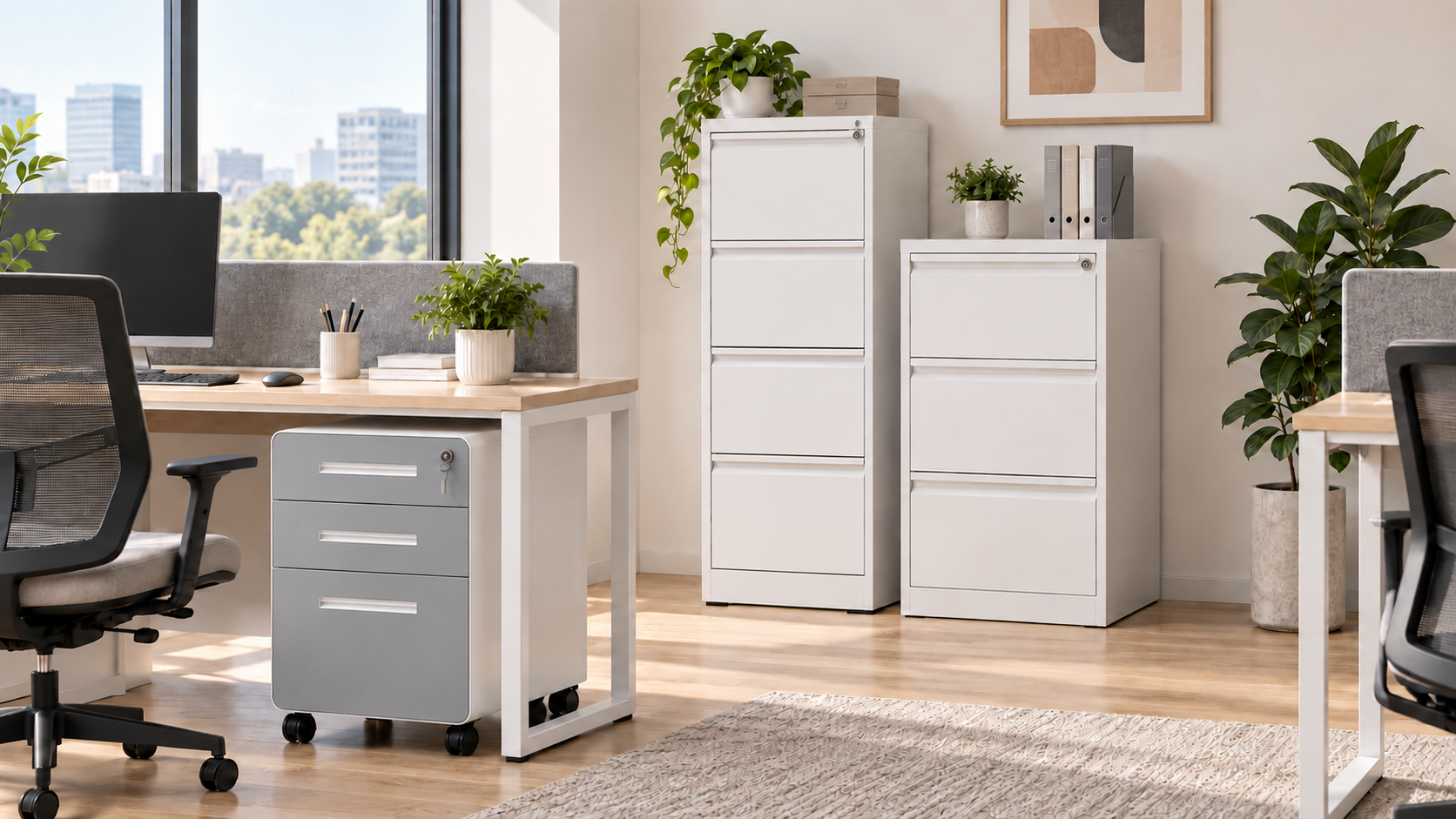
For more flexible office environments, some 2 drawer and 3 drawer filing cabinets can be equipped with casters, making them easier to reposition.
Mobile filing cabinets can be useful for:
- Open-plan offices
- Flexible workstations
- Shared offices
- Frequently changing office layouts
- Storage positioned beside workstations
If mobility is an important requirement, a lower cabinet with fewer drawers may therefore be the more practical choice.
5. More Drawers Can Mean Better File Classification
The number of drawers is not only about total storage capacity. It also determines how precisely documents can be organized.
A company may need to separate files according to customer, department, project, year, contract type, or other categories.
In this situation, having more drawers can make classification easier.
However, buyers should also pay attention to the size of each individual drawer.
Dongzhixin Furniture offers different filing cabinet structures, including our Hemel Series, which can provide more drawers within a similar overall cabinet height.
This gives buyers two different approaches:
Fewer, larger drawers are suitable for storing larger quantities of similar documents.
More, smaller drawers are useful when documents or office materials need to be separated into more categories.
Therefore, when comparing filing cabinets of a similar height, don't look at the exterior dimensions alone. Consider both drawer quantity and usable drawer capacity.
6. Consider Who Will Use the Filing Cabinet
Another useful way to determine the right number of drawers is to consider the number of users.
For an individual workstation, a 2 or 3 drawer filing cabinet is often enough for frequently accessed documents. Its lower height also makes it convenient to position close to a desk.
For departmental or shared storage, additional drawers can make organization easier. Different drawers can be assigned to different employees, projects, document categories, or periods.
In general:
Individual use → fewer drawers
Shared departmental use → more drawers
Centralized archive storage → higher-capacity, multi-drawer cabinets
The final configuration should always reflect how documents are actually managed in the workplace.
So, How Many Drawers Should You Choose?
There is no single drawer configuration that works for every office.
Instead of simply comparing a 2 drawer, 3 drawer, 4 drawer, or 5 drawer filing cabinet, consider these six questions:
- How much vertical space is available?
- How many files need to be stored?
- How much floor space can the cabinet occupy?
- Does the cabinet need to be moved frequently?
- How many document categories need to be separated?
- Will the cabinet be used by one person or shared by a department?
For personal workstations and flexible office layouts, 2 or 3 drawers can offer a practical balance between storage and mobility.
For offices with limited floor space but greater filing requirements, 4 or 5 drawers make better use of vertical space.
And when detailed classification is more important than simply increasing total capacity, a cabinet series with more drawers within a similar height may provide a more suitable solution.
The key is not to ask, “Which drawer number is best?” but rather:
“How many drawers does this particular office and filing system actually need?”

Custom Filing Cabinet Solutions from Dongzhixin Furniture
As a professional steel filing cabinet manufacturer, Dongzhixin Furniture offers multiple cabinet heights, drawer configurations, and storage solutions for different office environments.
Our standard range includes 2, 3, 4, and 5 drawer configurations, while other product series provide additional options for customers requiring different storage and classification solutions.
For office furniture distributors, wholesalers, brands, contractors, and bulk procurement projects, we also provide OEM and ODM services. Cabinet dimensions, drawer configurations, steel thickness, rails, locks, handles, casters, colors, packaging, and branding can be customized according to project and market requirements.
Whether you need mobile filing cabinets for individual workstations or high-capacity filing systems for large offices, Dongzhixin Furniture can help you develop the right configuration for your market or project.